In their first month at NPR, several interns have written sidebars for the NPR website. Check it out:
Erika Engelhaupt, Science Desk intern, wrote "Tailoring your Coffee Drink" for Alison Aubrey's September 28 story, "Coffee: A Little Really Does Go a Long Way" and helped write "Others Weigh in on Gallaudet Protests" for Joseph Shapiro's October 11 story, "Gallaudet's President Struggles with Protests."
Adeline Goss, Executive Producer of Intern Edition, wrote "Painting the Early Universe's Picture" for David Kestenbaum's October 3 story, "Big-Bang Detective Work Wins Physics Nobel."
Afton Woodward, Online intern, wrote "White Collar Crooks: Pleas and Punishments," for Wade Goodwyn's September 26 story, "Enron's Fastow seeks - and receives - Leniency."

- Next Generation Radio : Intern Edition
- Washington D.C./Los Angeles, United States
Wednesday, October 11, 2006


Friday, October 06, 2006
It's the Great Pumpkin, Charlie Brown!
 Nothing says "autumn" quite like pumpkin-harvesting in New England. But giant pumpkins? Lindsey Larson recounts her recent interviews for Intern Edition:
* * *
My Intern Edition story took me to Topsfield, MA last weekend to report on the 188th annual Topsfield Fair. Following a core team of five pumpkin growers over two days, I became well-versed in the particulars of growing the mythical giant pumpkin.

A squash of fantastic proportions, giant pumpkins can gain 30 to 40 pounds per day and require 500 gallons of water per day to support that fattening regimen. Each summer throughout New England, dedicated growers resign themselves to the garden for three whole months in hopes of winning the giant pumpkin weigh-off.

Five members of the Ipswich Bay Giant Pumpkin Growers Association invited me to help pick each others' special harvest. Using a tripod, which was once employed to move gravestones, they carefully lifted each pumpkin and placed it on a palette covered with rugs and couch cushions. The next morning, "convoys" of pumpkin growers arrived at the Topsfield Fair from across New England. They began unloading the pumpkins at 6 a.m. and the weigh-off got underway around nine.
Throughout the events of the morning, I interviewed both young and old to try to determine why they were obsessed with a vegetable that is - they admit it - ugly. With many weighing in at over 1,000 pounds, giant pumpkins maintain a variety of globular shapes and unusual colorings. At 1 o'clock, the judges announced the winner as the weight flashed on the digital screen: 1,347 pounds, a new Topsfield Fair record!
-Lindsey Larson, Radio Expeditions
Thursday, October 05, 2006
Ann's Gift
Last weekend, Adeline interviewed Arlington resident Ann Kennedy about her grapheme-color synesthesia. Below is her account of what Ann calls her "gift":
* * *
On Sunday, I took my reporter's kit to Arlington to interview Ann Kennedy, a grapheme-color synesthete. Synesthesia is a medical condition in which a person's senses are crossed rather than separate from each other, so that they may taste colors, feel music, or smell sounds. The experiences aren't limited to the traditional "senses." Every time Ann sees a number or letter of the alphabet, it appears in her mind's eye as a specific, unchanging color. Some doctors see this as a syndrome. Ann sees it as a gift.
 To illustrate what her mind sees, she took out a box of colored pencils and a pad of paper. Before I arrived, she had written my name not once but twice - the second time to get the color "right." The "d" in particular had been giving her trouble. The second one, she explained, was much more like "her" d.
Synesthetes on average have four different types of synesthesia, although some may be stronger than others. Ann insists that she's only a mild synesthete.
But as she and I conversed outside, a long, textured birdsong erupted from overhead, and she grinned, locking my eyes: "Silver!"
* * *
On Sunday, I took my reporter's kit to Arlington to interview Ann Kennedy, a grapheme-color synesthete. Synesthesia is a medical condition in which a person's senses are crossed rather than separate from each other, so that they may taste colors, feel music, or smell sounds. The experiences aren't limited to the traditional "senses." Every time Ann sees a number or letter of the alphabet, it appears in her mind's eye as a specific, unchanging color. Some doctors see this as a syndrome. Ann sees it as a gift.
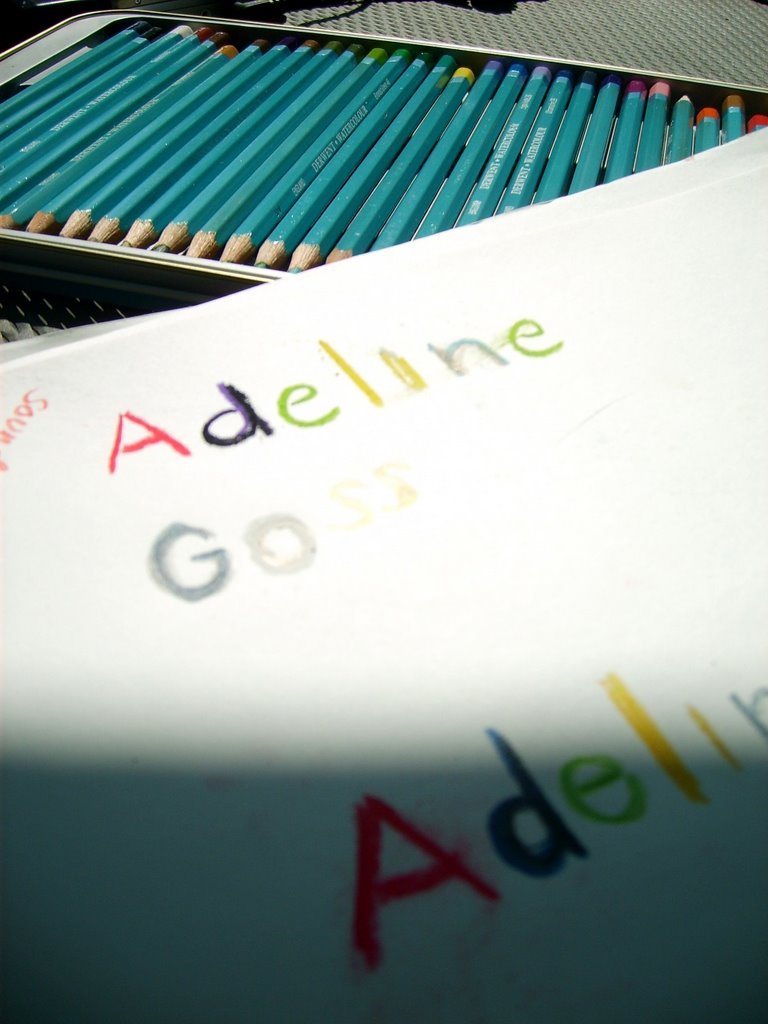 To illustrate what her mind sees, she took out a box of colored pencils and a pad of paper. Before I arrived, she had written my name not once but twice - the second time to get the color "right." The "d" in particular had been giving her trouble. The second one, she explained, was much more like "her" d.
 Synesthetes on average have four different types of synesthesia, although some may be stronger than others. Ann insists that she's only a mild synesthete.
But as she and I conversed outside, a long, textured birdsong erupted from overhead, and she grinned, locking my eyes: "Silver!"
-Adeline Goss, Executive Producer of Intern Edition
10/4 Intern Edition Meeting
For this week's Intern Edition meeting, we had guest speakers NPR Arts and Information reporter David Folkenflik and John Barth, managing director of PRX. David shared valuable information on interviewing people and how to deal with problems that might pop up. The most important things seemed to be 1) don't talk too much as the interviewer, 2) be prepared before you start an interview, 3) get comfortable with your equipment, 4) don't ask yes and no questions, and 5) really listen to what the person is saying.

Interns gather around to listen to
David's engrossing stories.

Interns gather around to listen to
David's engrossing stories.
John Barth is the director of Public Radio Exchange, a website that is "a web-based marketplace for public radio pieces. Programmers find and air work from other stations, independent producers and international broadcasters. Producers - station-based or independent - license their work directly to stations." (Taken from the website at www.prx.org. For more information about PRX, please go to the website. )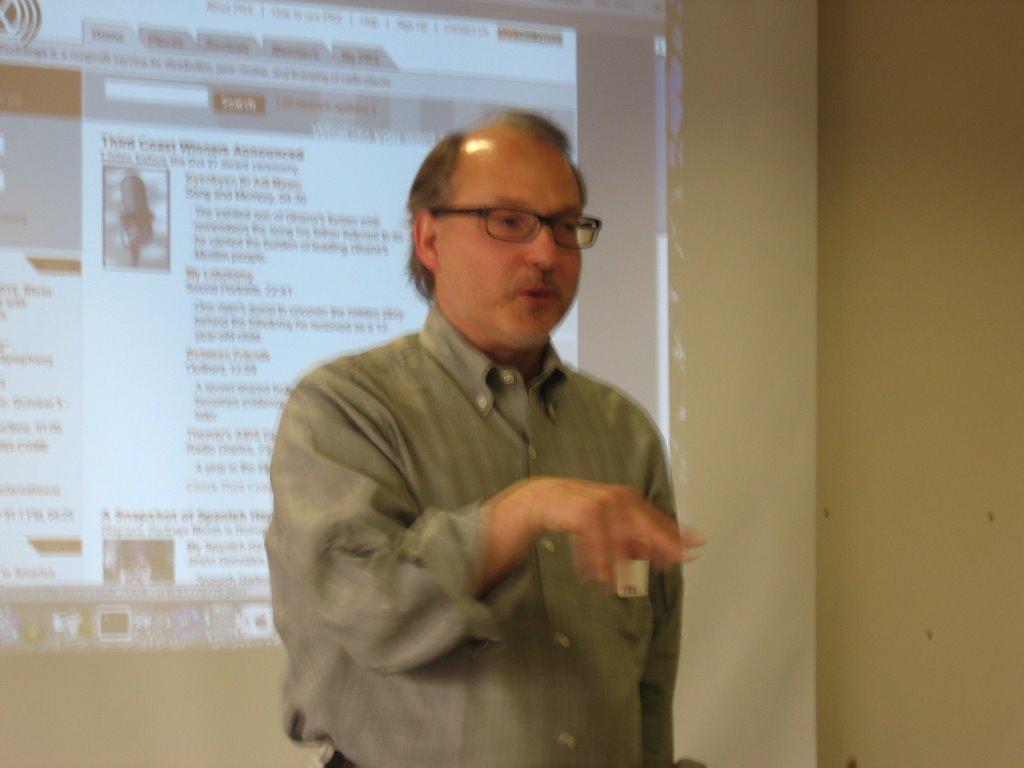
John encourages the group to add their
own radio pieces onto PRX's site.
We would like to thank both David and John for taking some time out of their day to speak with us.
Bertina Yu, Washington Desk/IE Blog Editor
Friday, September 29, 2006
Borat Visits White Houses for to Make Invitation to Movie-Film
This morning I was sitting at my computer, simultaneously watching the wires for updates on Terrell Owens’s alleged “suicide attempt” and debating whether or not to mention that I have eczema in my intern bio (verdict: affirmative), when I suddenly received a frantic message from my friend Cheddar Ted, a fledgling reporter at The Observer in New York:
“GET OUT OF THE OFFICE, GRITZ! Borat is in DC, call this number!”
Wasting only a little bit of time, I called the number and asked a publicist to give me the 411 on the whole sid-u-ation.
She said, “You’re from NPR? Hold on, let me drop everything else I’m doing to tell you about it.”
She returned and said, “16th St. and O, 1:30pm.”
Braving temperatures close to 80 degrees Fahrenheit, I hiked over to the corner of 16th and O, where the Kazakhstan Embassy was located. A steady trickle of cameras, soundmen, and media types began congregating. Someone set up a podium with the Kazakh flag hanging proudly besides the Stars and Stripes, and Borat appeared down the block, dressed in his trademark gray suit and toting his clipboard. He then took to the podium. There he delivered a statement denying rumors that the Kazakh government was displeased with his portrayal of Kazakhstan in his forthcoming film, Borat: Cultural Learnings of America for Make Benefit Glorious Nation of Kazakhstan. He blamed these statements on Uzbek spies who were tampering with statements and spreading propaganda.
After failing to open the gate of the embassy, where he wanted to “make meeting with government,” he turned to the crowd and asked, “Please you can tell me where is the white houses?”
Someone replied, “Uhhh, the White House is that way,” and Borat started power walking down 16th.
One of the most amusing parts of the spectacle was watching all the TV people running down the street, knocking over innocent bystanders, and yelling into their Blackberries to coordinate crews to pick Borat up at the White House.
Once he arrived in front of the White House, Borat approached three policemen and asked, “Where is white houses?” to which they responded, “Right in front of you.”
He then asked, “How I make entrance, please?” The cops forlornly pointed towards the security gate.
The White Houses guards appeared unamused by Borat’s request: “Please I can come in? I like make invitation to Premier George Wilson Bush to see my movie-film. Afterward we have cocktail party where make discussion between our government.”
After passing along his message, Borat strolled into a waiting SUV and set off “to buy a coffees for my leader, and also an M and M.”
As the media crowd dispersed, I spied a Potbelly’s Sandwich Works across the street and bought a delicious sandwich. Then I went back to work.
This is literally what it’s like to be an NPR Intern.
- Chris Schonberger, Weekend Edition Saturday
*Disclaimer: British comedian Sacha Baron Cohen created the character of Borat and was in Washington D.C. to promote his upcoming film
“GET OUT OF THE OFFICE, GRITZ! Borat is in DC, call this number!”
Wasting only a little bit of time, I called the number and asked a publicist to give me the 411 on the whole sid-u-ation.
She said, “You’re from NPR? Hold on, let me drop everything else I’m doing to tell you about it.”
She returned and said, “16th St. and O, 1:30pm.”
Braving temperatures close to 80 degrees Fahrenheit, I hiked over to the corner of 16th and O, where the Kazakhstan Embassy was located. A steady trickle of cameras, soundmen, and media types began congregating. Someone set up a podium with the Kazakh flag hanging proudly besides the Stars and Stripes, and Borat appeared down the block, dressed in his trademark gray suit and toting his clipboard. He then took to the podium. There he delivered a statement denying rumors that the Kazakh government was displeased with his portrayal of Kazakhstan in his forthcoming film, Borat: Cultural Learnings of America for Make Benefit Glorious Nation of Kazakhstan. He blamed these statements on Uzbek spies who were tampering with statements and spreading propaganda.
After failing to open the gate of the embassy, where he wanted to “make meeting with government,” he turned to the crowd and asked, “Please you can tell me where is the white houses?”
Someone replied, “Uhhh, the White House is that way,” and Borat started power walking down 16th.
One of the most amusing parts of the spectacle was watching all the TV people running down the street, knocking over innocent bystanders, and yelling into their Blackberries to coordinate crews to pick Borat up at the White House.
Once he arrived in front of the White House, Borat approached three policemen and asked, “Where is white houses?” to which they responded, “Right in front of you.”
He then asked, “How I make entrance, please?” The cops forlornly pointed towards the security gate.
The White Houses guards appeared unamused by Borat’s request: “Please I can come in? I like make invitation to Premier George Wilson Bush to see my movie-film. Afterward we have cocktail party where make discussion between our government.”
After passing along his message, Borat strolled into a waiting SUV and set off “to buy a coffees for my leader, and also an M and M.”
As the media crowd dispersed, I spied a Potbelly’s Sandwich Works across the street and bought a delicious sandwich. Then I went back to work.
This is literally what it’s like to be an NPR Intern.
- Chris Schonberger, Weekend Edition Saturday
*Disclaimer: British comedian Sacha Baron Cohen created the character of Borat and was in Washington D.C. to promote his upcoming film
The Celebrity Status
Becoming an intern at NPR was an unexpected but pleasant surprise for me this fall. As a recent graduate with a master’s degree, I suddenly found myself with a lot of time on my hands over the summer, and in between waiting for news from various jobs, I had a recurring idea: why not apply for an internship at NPR? It had always been something I wanted to do in college, but had always neglected to go through with—I think I was a little intimidated by the caliber of past interns in addition to having absolutely no background in journalism.
Of course, after getting the news that I had been accepted into NPR’s internship program, I immediately told everyone I knew. My family and my friends, all longtime NPR listeners, kept making me promise that I would update them with any interesting stories I had during my internship. So guys, this one’s for you.
Do you remember running into your teacher at the store and being so taken aback by the fact that they had actual lives outside of their job? In a sense, that is exactly how I felt the first time that Mara Liasson stopped by my desk. She was friendly and easygoing, although I’m sure she was wondering why I was mute for a good minute or so, but she was very gracious about it.
It never occurred to me that I would be on the exact same floor as people I had listened to or seen on television; that is I never really thought of what it’d be like to meet all of these famous people. Because of their “celebrity” status, it’s sometimes hard to remember that they too do normal things like shopping, or taking care of the kids. I used to think that it would be really intimidating to talk to someone who was famous, or that I would be seen as an annoying fan. But one thing I always keep in mind now, particularly after meeting Mara is that the celebrities here at NPR are extremely approachable and after getting past that moment of being starstruck, I learned that it was much easier getting to know them than I thought it would be. Plus, I’ve heard that an NPR reporter sees Karl Rove pretty regularly at his local grocery store, which once again reminds me that we all have lives outside of our jobs.
-Bertina Yu, Washington Desk/Intern Edition Blog Editor
Addie's Golden Rule
Eight members of my family called this week to ask how things were going with the internship. This is heartwarming, since out of all my relatives - four parents, four grandmothers, and 30 cousins - only one person actually listens to NPR. But they've apparently realized over the years that my dream was to work in this building, and here I am. I'm not even paid, and I'm thrilled.
That's what I tell my grandmothers when they call me, and they're satisfied. But my friends from Brown, many of whom were virtually weaned on public radio, want to know more. Mostly they ask me if I eat in the same lunchroom as Robert Siegel.
And I say, "That's funny, actually. Because just the other day..."
Just the other day, I got back from shadowing Guy Raz on an interview and went up to the lunchroom. I stood in line behind a very well-dressed man and immediately thought something was up - people just don't dress like that in public radio. He turned around a moment later and asked my name.
"Addie Goss, what's yours?"
"Murblecose..." he answered, or something like that. I haven't yet developed the fundamental reporting skill of listening to people's names.
"So what do you do here?" he asked, and I explained that I'm an intern, that I'm the executive producer of Intern Edition, that I just graduated from Brown, that I biked across America this summer, the whole bio, rambling because this man was in a suit.
I finally gasped, "What do you do here?"
"I'm the President," he said. "Of NPR."
I fell in love with radio in middle school. But reporting for Brown Student Radio was something else - stressful, time-consuming, and never quite perfect. What kept me from jumping ship and taking the LSATs was that everyone in radio is so great. They're blindingly smart and creative. They're also humble and kind to stammering interns.
Kevin Klose kept me talking. We ordered and paid for lunch, then he picked up his soup and said, "Bye, Addie!"
That meant something. Remember people's names. If there's one thing I learn here, that's it.
-Adeline Goss, Executive Producer of Intern Edition
That's what I tell my grandmothers when they call me, and they're satisfied. But my friends from Brown, many of whom were virtually weaned on public radio, want to know more. Mostly they ask me if I eat in the same lunchroom as Robert Siegel.
And I say, "That's funny, actually. Because just the other day..."
Just the other day, I got back from shadowing Guy Raz on an interview and went up to the lunchroom. I stood in line behind a very well-dressed man and immediately thought something was up - people just don't dress like that in public radio. He turned around a moment later and asked my name.
"Addie Goss, what's yours?"
"Murblecose..." he answered, or something like that. I haven't yet developed the fundamental reporting skill of listening to people's names.
"So what do you do here?" he asked, and I explained that I'm an intern, that I'm the executive producer of Intern Edition, that I just graduated from Brown, that I biked across America this summer, the whole bio, rambling because this man was in a suit.
I finally gasped, "What do you do here?"
"I'm the President," he said. "Of NPR."
I fell in love with radio in middle school. But reporting for Brown Student Radio was something else - stressful, time-consuming, and never quite perfect. What kept me from jumping ship and taking the LSATs was that everyone in radio is so great. They're blindingly smart and creative. They're also humble and kind to stammering interns.
Kevin Klose kept me talking. We ordered and paid for lunch, then he picked up his soup and said, "Bye, Addie!"
That meant something. Remember people's names. If there's one thing I learn here, that's it.
-Adeline Goss, Executive Producer of Intern Edition
Subscribe to:
Posts (Atom)