I had a catalytic conversation with a man on the bus the other day. It shouldn’t have sparked my train of thought the way it did. It was nothing but small talk, really. The exchange went something like this…
“Where do you intern?”
“National Public Radio”
“What’s that? I’ve never heard of it.”
“Oh, NPR is—“
“You intern at NPR!?! I love NPR! I listen all the time.”
I smiled (a little) and the conversation continued until I reached my stop. That should have been the end of it, and it probably was for my in-transit companion. I, however, couldn’t stop thinking about it, or rather, I couldn’t stop thinking about them—acronyms, that is. Now, before you think “Josh has lost it,” hear me out.
NPR (you may know it as National Public Radio), has a virtual lexicon of company-specific terminology. Learning the workplace vocabulary can be a formidable task, just ask any intern. The difficulty of mastering “NPRspeak” is compounded by the fact that approximately 95% of the new terms are, you guessed it, acronyms. Acronyms like ATC, EDL, ENPS, ISDN, ZFLINKERT, (okay I made the last one up, but you get the point). Acronyms are everywhere at NPR. I bet your company is the same.
And this acronymo-logical phenomenon isn’t limited to the workplace. We have acronyms for everything. Our nation’s capital is two-thirds acronym (who says “Washington, District of Columbia? Honestly.). Some of the most important organizations, programs, and people in American history are acronyms. FDR, JFK, the UN, the NAACP, the ACLU, the WPA, NAFTA, and the list goes on. By this point you’re probably thinking, “so what?” well, I’m not going to insult your intelligence by imagining that you don’t know how acronyms work, but each one of those letters represents a word, and, more importantly, each of those words represents a concept, ideal, truth, or person. When we forget that, we forget why those acronyms are important.
If we don’t know the words behind the letters, we’re more likely to forget the concepts and values those letters stand for. In my book, that’s a dangerous way to live—without values. It’s even worse when the entities behind the acronyms forget what those letters stand for. Perhaps that’s how organizations can come to act in ways that are completely opposite the values they profess to stand for. Perhaps that’s how leaders, lawyers, and lay members of these organizations can fall so far from the original ideal. Perhaps that’s why these organizations can be so intolerant of each other—because they’ve forgotten what it is they stand for. What would the ACLU be without the L? What would the NAACP be without the P? You see, it’s not about the associations; it’s about the people. It’s about their liberties. And I’m worried that we’re forgetting.
In the big picture, does it really matter that ENPS stands for Electronic News Production System? Probably not. But does it matter that UN stands for United Nations? I think it does.
-Josh Figueira

- Next Generation Radio : Intern Edition
- Washington D.C./Los Angeles, United States
Showing posts with label Reflection. Show all posts
Showing posts with label Reflection. Show all posts
Wednesday, November 22, 2006


Thursday, October 05, 2006
Ann's Gift
Last weekend, Adeline interviewed Arlington resident Ann Kennedy about her grapheme-color synesthesia. Below is her account of what Ann calls her "gift":
* * *
On Sunday, I took my reporter's kit to Arlington to interview Ann Kennedy, a grapheme-color synesthete. Synesthesia is a medical condition in which a person's senses are crossed rather than separate from each other, so that they may taste colors, feel music, or smell sounds. The experiences aren't limited to the traditional "senses." Every time Ann sees a number or letter of the alphabet, it appears in her mind's eye as a specific, unchanging color. Some doctors see this as a syndrome. Ann sees it as a gift.
 To illustrate what her mind sees, she took out a box of colored pencils and a pad of paper. Before I arrived, she had written my name not once but twice - the second time to get the color "right." The "d" in particular had been giving her trouble. The second one, she explained, was much more like "her" d.
Synesthetes on average have four different types of synesthesia, although some may be stronger than others. Ann insists that she's only a mild synesthete.
But as she and I conversed outside, a long, textured birdsong erupted from overhead, and she grinned, locking my eyes: "Silver!"
* * *
On Sunday, I took my reporter's kit to Arlington to interview Ann Kennedy, a grapheme-color synesthete. Synesthesia is a medical condition in which a person's senses are crossed rather than separate from each other, so that they may taste colors, feel music, or smell sounds. The experiences aren't limited to the traditional "senses." Every time Ann sees a number or letter of the alphabet, it appears in her mind's eye as a specific, unchanging color. Some doctors see this as a syndrome. Ann sees it as a gift.
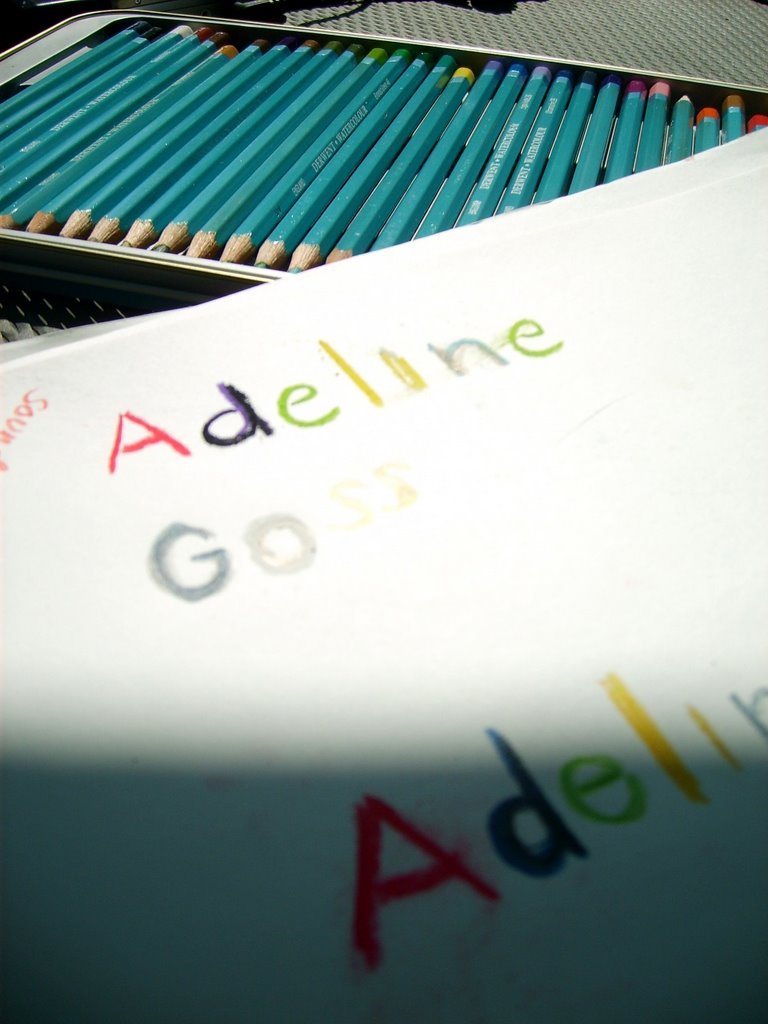 To illustrate what her mind sees, she took out a box of colored pencils and a pad of paper. Before I arrived, she had written my name not once but twice - the second time to get the color "right." The "d" in particular had been giving her trouble. The second one, she explained, was much more like "her" d.
 Synesthetes on average have four different types of synesthesia, although some may be stronger than others. Ann insists that she's only a mild synesthete.
But as she and I conversed outside, a long, textured birdsong erupted from overhead, and she grinned, locking my eyes: "Silver!"
-Adeline Goss, Executive Producer of Intern Edition
Subscribe to:
Posts (Atom)