In the world of public radio, there is a war brewing, a war unbeknownst to the public who listen to public radio. Behind the scenes of this war are the big three: National Public Radio, Public Radio International, and American Public Media. It’s a fierce and brutal war for market share—the listener—and name recognition. So far, NPR is leading, with its cutthroat programming, such as Morning Edition and All Things Considered. Few people even recognize that the programming they are listening to is from different media organizations. Mainly listeners would think that the shows they listen to come from the same source…NPR. In fact programs come from many different sources including the big three and privately owned local member stations. For now the fight continues with each new story pitch out-doing the last. The “This I believe” series has captured the hearts and minds of--to be continued...
-Jason Hesch

- Next Generation Radio : Intern Edition
- Washington D.C./Los Angeles, United States
Showing posts with label radio. Show all posts
Showing posts with label radio. Show all posts
Wednesday, November 29, 2006


Wednesday, November 22, 2006
Descent into the library: How to bake a tape
I spend a lot of time combing the shelves of the broadcast library for NPR programs recorded circa 1991. The dates, written in tiny symbols, blur in front of my eyes and I come back 2, 4 and 6 times a day sometimes, when I’ve pulled the wrong CD’s. NPR is in the process of transferring their past shows from reels of magnetic tape onto the (hopefully) more stable CD’s. 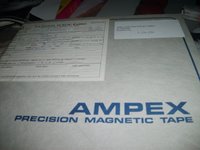 The task seems enormous when you consider that shows were archived on tape as late as the mid-nineties. Every time I went into the library, I’d close my eyes and hope that what I needed would be available in digital format. If it wasn’t I wouldn’t spend triple the time getting a reel, bringing it to an engineer, finding the correct segment (no track markers remember) and finally, digitally uploading it into the network. I only learned to thread the tape into a player myself a few days ago. The task reminded me of being one of the highly lauded AV helpers at my elementary school and negotiating the labyrinthine twists of the classroom projector. Knowing how to do this speeds up the process and annoys the engineers less. Now, I can find the correct place on the tape myself, mark it with special non-sticky paper and hand it to the engineer with less fuss.
I stumbled across the more obscure part of this story when I had to order a tape from outside of the building. The audio I needed came from a Morning Edition show from April 1981. Tapes from that year are kept at another site, since the library is small and the archive now spans 30 years. I placed my order and was advised that the time needed to get it to me would include a period of baking. What?! Baking?
Yeah, baking. So, here’s what happens. Older tapes, when they’ve sat on the shelf for a number of years, develop an uncomfortable form of tape dermatitis—“sticky shed syndrome.” This means that the tape binder, the glue used to connect the magnetic and plastic parts of the tape, has absorbed water over its long shelf life. This makes the tape stick to the player’s heads and renders it unplayable—or at least the sound quality isn’t great.
I did a little research on the topic, talked with a couple librarians and found out some of the back story on this insidious disease.
Not all tapes develop sticky shed syndrome. The tapes with the sub-par binder were manufactured in the mid-seventies to late eighties. Why does the tape from those years become sticky, you ask? The answer involves whale blubber.
The answer that this article and our friendly NPR library gave is to bake the tape! Yes, literally stick it into an oven. This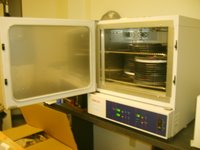 removes the moisture that’s built up in the binder and makes the tape playable again. Sound easy? Well, there are a couple of catches. For instance, the tape should be baked at a steady 130° F, which means you need an accurate oven. NPR uses a laboratory oven for the job.
And the process takes time—around 4-6 hours. You absolutely can’t use a microwave oven either and the biggest catch is: this doesn’t fix the tape for ever, just a couple months at best.
Although this is a fascinating look into the obscure world of audio archiving, for me, knowing this story brings up all sorts of questions about the longevity of information. As one librarian remarked to me, stone tablets are probably the best way of preserving something. They are not, however, easy to store or cost effective. CD’s are cheap and small but they have only been around for 25 years and no one knows what kind of problems they might develop in another 20 (digital psoriasis perhaps?). In fact, archivist still prefer magnetic tape as a superior method for audio archiving, with a binder resistant to sticky shed of course. Also, as any computer users knows, the larger problem with archiving media digitally is the frequent failure of electronic storage. Computers crash, hard drives are wiped clean and no amount of baking can bring them back.
For information on baking tapes you can go here for all you ever wanted to know and more about creating piping-hot and usable tape.
-Joanna Stein
 The task seems enormous when you consider that shows were archived on tape as late as the mid-nineties. Every time I went into the library, I’d close my eyes and hope that what I needed would be available in digital format. If it wasn’t I wouldn’t spend triple the time getting a reel, bringing it to an engineer, finding the correct segment (no track markers remember) and finally, digitally uploading it into the network. I only learned to thread the tape into a player myself a few days ago. The task reminded me of being one of the highly lauded AV helpers at my elementary school and negotiating the labyrinthine twists of the classroom projector. Knowing how to do this speeds up the process and annoys the engineers less. Now, I can find the correct place on the tape myself, mark it with special non-sticky paper and hand it to the engineer with less fuss.
 I stumbled across the more obscure part of this story when I had to order a tape from outside of the building. The audio I needed came from a Morning Edition show from April 1981. Tapes from that year are kept at another site, since the library is small and the archive now spans 30 years. I placed my order and was advised that the time needed to get it to me would include a period of baking. What?! Baking?
Yeah, baking. So, here’s what happens. Older tapes, when they’ve sat on the shelf for a number of years, develop an uncomfortable form of tape dermatitis—“sticky shed syndrome.” This means that the tape binder, the glue used to connect the magnetic and plastic parts of the tape, has absorbed water over its long shelf life. This makes the tape stick to the player’s heads and renders it unplayable—or at least the sound quality isn’t great.
I did a little research on the topic, talked with a couple librarians and found out some of the back story on this insidious disease.
Not all tapes develop sticky shed syndrome. The tapes with the sub-par binder were manufactured in the mid-seventies to late eighties. Why does the tape from those years become sticky, you ask? The answer involves whale blubber.
WHALE'S REVENGE
At least part of the answer lies in that great '70s crusade, to 'save the whale'. As a result of the environmental lobby in the US, tape manufacturers Ampex were stampeded into abandoning their traditional whale oil tape-binder (the binder is the material used to fix the tiny particles of magnetic oxide to the tape's flexible backing tape). Ampex's synthetic substitute, perhaps because it was formulated without the normal research and development, has since undergone some form of chemical breakdown, and at the same time, absorbed moisture from the air. The problem was identified, and improved formulations substituted to clear the problem, but that still left thousands of reels of tape around the world that were literally rotting away. What, if anything can you do to recover material archived in this way
The answer that this article and our friendly NPR library gave is to bake the tape! Yes, literally stick it into an oven. This
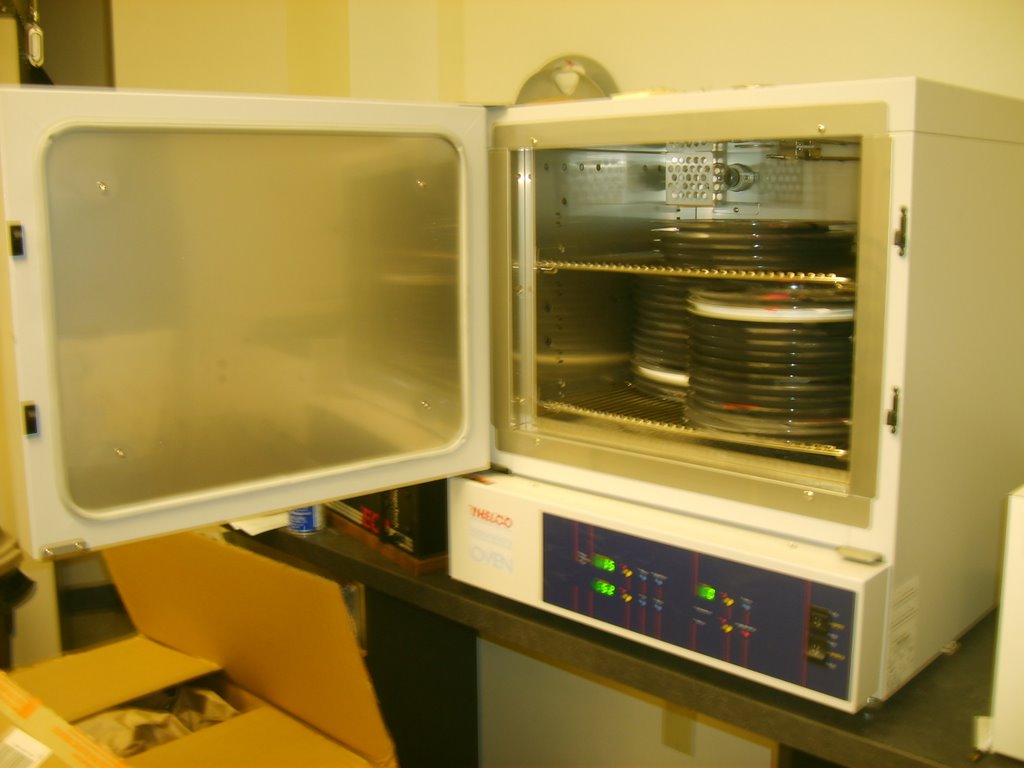 removes the moisture that’s built up in the binder and makes the tape playable again. Sound easy? Well, there are a couple of catches. For instance, the tape should be baked at a steady 130° F, which means you need an accurate oven. NPR uses a laboratory oven for the job.
And the process takes time—around 4-6 hours. You absolutely can’t use a microwave oven either and the biggest catch is: this doesn’t fix the tape for ever, just a couple months at best.
Although this is a fascinating look into the obscure world of audio archiving, for me, knowing this story brings up all sorts of questions about the longevity of information. As one librarian remarked to me, stone tablets are probably the best way of preserving something. They are not, however, easy to store or cost effective. CD’s are cheap and small but they have only been around for 25 years and no one knows what kind of problems they might develop in another 20 (digital psoriasis perhaps?). In fact, archivist still prefer magnetic tape as a superior method for audio archiving, with a binder resistant to sticky shed of course. Also, as any computer users knows, the larger problem with archiving media digitally is the frequent failure of electronic storage. Computers crash, hard drives are wiped clean and no amount of baking can bring them back.
For information on baking tapes you can go here for all you ever wanted to know and more about creating piping-hot and usable tape.
-Joanna Stein
Wednesday, November 15, 2006
Plug no more
Since I guess I'm the blog's liason to the greater world of radio, below is a link to talks at the Third Coast Festival (October) by NPR's Danny Zwerdling and Joe Richman, author of Radio Diaries (and specifically Thembi's Diary, which I've plugged earlier and will plug and plug til I can't plug no more)...
I turn the mic over to Third Coast's most recent info email:
"THE 2006 CONFERENCE FROM THE COMFORT OF YOUR FAVORITE COFFEE SHOP
For those who couldn't join us for our recent 2006 conference, and those who want a second helping, we've just posted all of the panels and breakouts for your edification and pleasure. Words of audio wisdom from the likes of Nancy Updike, Joe Richman, Rob Rosenthal, Daniel Zwerdling and Marilyn Pittman are just a click away.
I turn the mic over to Third Coast's most recent info email:
"THE 2006 CONFERENCE FROM THE COMFORT OF YOUR FAVORITE COFFEE SHOP
For those who couldn't join us for our recent 2006 conference, and those who want a second helping, we've just posted all of the panels and breakouts for your edification and pleasure. Words of audio wisdom from the likes of Nancy Updike, Joe Richman, Rob Rosenthal, Daniel Zwerdling and Marilyn Pittman are just a click away.
- Adeline Goss
Monday, October 30, 2006
Third Coast Festival
Maybe you, like me, were devouring updates from the Third Coast Festival Conference in Chicago last week... but if you weren't...
Third Coast is an annual gathering of audio producers from across the radio spectrum -- public radio, experimental sound, documentarians. It's held each fall in Chicago and draws regulars like Ira Glass and NPR's Robert Krulwich and Danny Zwerdling.
THIRD COAST AWARD WINNERS
Previews of all the winners' stories are available on the Third Coast site. Here are links to a few of the full stories:
Thembi's Diary -- Joe Richman, Radio Diaries
Kyenkyen Bi Adi Mawu -- Ann Heppermann, Kara Oehler and Rick Moody
Rhapsody in Bohemia, Alan Hall, Falling Tree productions
My Lobotomy -- Dave Isay / Soundportraits
99 WAYS TO TELL A RADIO STORY
Commissioned before the conference, each of these shortdocs represents a different production style, lasts 2 min and 30 sec, starts with some manifestation of the sentence "To begin with, they never got along," and includes the following sounds: a pre-recorded voice, a rhythmic noise and an exclamation (in that order). Some highlights:
#3: The First Attraction by Lawrence Lanahan and Bruce Wallace. The myth of Narcissus reimagined: the north pole of a magnet bar falls tragically in love with the north pole of another magnet bar. Production style: "mythomagnetic."
#27: The Secret Life of an Australian Mother by Eurydice Aroney, Tom Morton, Stuart Brown. A domestic duet for a mother and six year old. Production style: "hysteria verite."
99 Ways will continue accepting submissions until December 31 or until they reach 99 (they're currently at 73), whichever comes first. So get busy!
HOOKED? THERE'S MORE:
- Transom.org's blog about the talks and events at Third Coast (Transom.org, for the uninitiated, is a boundless audio resource). Bloggers include Robin Amer and Greta Pemberton of PRI's Open Source and, formerly, the world-famous Brown Student Radio.
- Third Coast's links to audio sites
- Third Coast 2006 audio archives, with stories by Rick Moody, Danny Zwerdling, among others.
That should be enough to keep you busy for a few months! Enjoy.
- Adeline Goss
Third Coast is an annual gathering of audio producers from across the radio spectrum -- public radio, experimental sound, documentarians. It's held each fall in Chicago and draws regulars like Ira Glass and NPR's Robert Krulwich and Danny Zwerdling.
THIRD COAST AWARD WINNERS
Previews of all the winners' stories are available on the Third Coast site. Here are links to a few of the full stories:
Thembi's Diary -- Joe Richman, Radio Diaries
Kyenkyen Bi Adi Mawu -- Ann Heppermann, Kara Oehler and Rick Moody
Rhapsody in Bohemia, Alan Hall, Falling Tree productions
My Lobotomy -- Dave Isay / Soundportraits
99 WAYS TO TELL A RADIO STORY
Commissioned before the conference, each of these shortdocs represents a different production style, lasts 2 min and 30 sec, starts with some manifestation of the sentence "To begin with, they never got along," and includes the following sounds: a pre-recorded voice, a rhythmic noise and an exclamation (in that order). Some highlights:
#3: The First Attraction by Lawrence Lanahan and Bruce Wallace. The myth of Narcissus reimagined: the north pole of a magnet bar falls tragically in love with the north pole of another magnet bar. Production style: "mythomagnetic."
#27: The Secret Life of an Australian Mother by Eurydice Aroney, Tom Morton, Stuart Brown. A domestic duet for a mother and six year old. Production style: "hysteria verite."
99 Ways will continue accepting submissions until December 31 or until they reach 99 (they're currently at 73), whichever comes first. So get busy!
HOOKED? THERE'S MORE:
- Transom.org's blog about the talks and events at Third Coast (Transom.org, for the uninitiated, is a boundless audio resource). Bloggers include Robin Amer and Greta Pemberton of PRI's Open Source and, formerly, the world-famous Brown Student Radio.
- Third Coast's links to audio sites
- Third Coast 2006 audio archives, with stories by Rick Moody, Danny Zwerdling, among others.
That should be enough to keep you busy for a few months! Enjoy.
- Adeline Goss
Friday, October 20, 2006
Sound Off
Many of us NPR interns started out as NPR addicts. We came to believe in radio, and the next logical step was to make radio. What were the stories that hooked us? Adeline Goss, the Executive Producer of Intern Edition, will start us off...
Alix Spiegel, This American Life, "Pray"
Dave Isay, Sound Portraits, "Ghetto Life 101"
Dave Isay, Sound Portraits, "The Sunshine Hotel"
Dave Isay and Richard Sandler, Sound Portraits, "The Gods of Times Square"
Dave Isay and Stacy Abramson, Sound Portraits, "Witness to an Execution"
Jay Allison and Joe Richman, Radio Diaries, " Laura Rothenberg: My So-Called Lungs"
Jay Allison, Radio Diaries/New York Works, "Walter the Seltzer Man"
Jay Allison and Annie Cheney, Radio Diaries, "Concerning Breakfast"
Jay Allison and Nubar Alexanian, Transom, "Perfect Hearing"
Joe Richmond, Radio Diaries, "Thembi's AIDS Diary"
Robert Krulwich, All Things Considered, "The Little Coffee Plant that Wouldn't Die"
Scott Carrier, This American Life, "Running After Antelope"
Scott Carrier, Transom, "The West Desert"
Interns: submit your own favorites by writing to byu@npr.org.
Alix Spiegel, This American Life, "Pray"
Dave Isay, Sound Portraits, "Ghetto Life 101"
Dave Isay, Sound Portraits, "The Sunshine Hotel"
Dave Isay and Richard Sandler, Sound Portraits, "The Gods of Times Square"
Dave Isay and Stacy Abramson, Sound Portraits, "Witness to an Execution"
Jay Allison and Joe Richman, Radio Diaries, " Laura Rothenberg: My So-Called Lungs"
Jay Allison, Radio Diaries/New York Works, "Walter the Seltzer Man"
Jay Allison and Annie Cheney, Radio Diaries, "Concerning Breakfast"
Jay Allison and Nubar Alexanian, Transom, "Perfect Hearing"
Joe Richmond, Radio Diaries, "Thembi's AIDS Diary"
Robert Krulwich, All Things Considered, "The Little Coffee Plant that Wouldn't Die"
Scott Carrier, This American Life, "Running After Antelope"
Scott Carrier, Transom, "The West Desert"
Interns: submit your own favorites by writing to byu@npr.org.
Thursday, October 05, 2006
Ann's Gift
Last weekend, Adeline interviewed Arlington resident Ann Kennedy about her grapheme-color synesthesia. Below is her account of what Ann calls her "gift":
* * *
On Sunday, I took my reporter's kit to Arlington to interview Ann Kennedy, a grapheme-color synesthete. Synesthesia is a medical condition in which a person's senses are crossed rather than separate from each other, so that they may taste colors, feel music, or smell sounds. The experiences aren't limited to the traditional "senses." Every time Ann sees a number or letter of the alphabet, it appears in her mind's eye as a specific, unchanging color. Some doctors see this as a syndrome. Ann sees it as a gift.
 To illustrate what her mind sees, she took out a box of colored pencils and a pad of paper. Before I arrived, she had written my name not once but twice - the second time to get the color "right." The "d" in particular had been giving her trouble. The second one, she explained, was much more like "her" d.
Synesthetes on average have four different types of synesthesia, although some may be stronger than others. Ann insists that she's only a mild synesthete.
But as she and I conversed outside, a long, textured birdsong erupted from overhead, and she grinned, locking my eyes: "Silver!"
* * *
On Sunday, I took my reporter's kit to Arlington to interview Ann Kennedy, a grapheme-color synesthete. Synesthesia is a medical condition in which a person's senses are crossed rather than separate from each other, so that they may taste colors, feel music, or smell sounds. The experiences aren't limited to the traditional "senses." Every time Ann sees a number or letter of the alphabet, it appears in her mind's eye as a specific, unchanging color. Some doctors see this as a syndrome. Ann sees it as a gift.
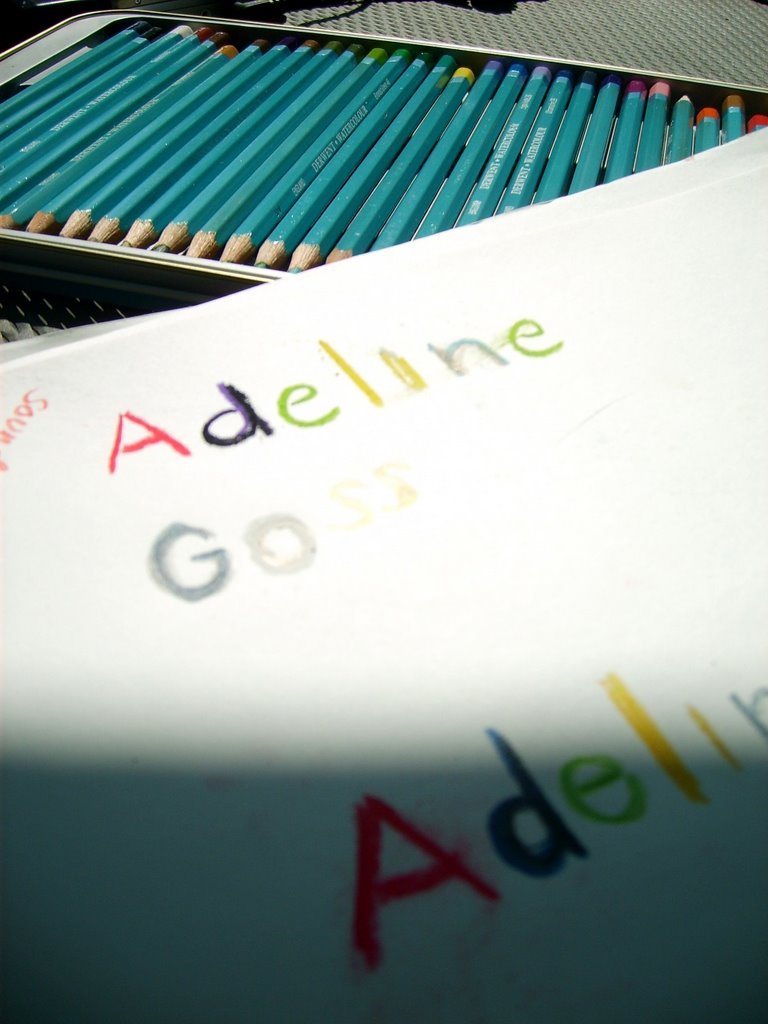 To illustrate what her mind sees, she took out a box of colored pencils and a pad of paper. Before I arrived, she had written my name not once but twice - the second time to get the color "right." The "d" in particular had been giving her trouble. The second one, she explained, was much more like "her" d.
 Synesthetes on average have four different types of synesthesia, although some may be stronger than others. Ann insists that she's only a mild synesthete.
But as she and I conversed outside, a long, textured birdsong erupted from overhead, and she grinned, locking my eyes: "Silver!"
-Adeline Goss, Executive Producer of Intern Edition
Subscribe to:
Posts (Atom)